Loose agent run
Work splits faster than ownership
Codex app skill
Plan large work, split it safely, verify progress, and resume without losing context.
npx skills add jddelia/software-factory \
  --agent codex \
  --global \
  --yes
Keep one active writer by default, then route review and feedback without collisions.
Leave project records that explain what changed, what passed, and what still needs attention.
Treat checks, screenshots, logs, and review notes as part of delivery, not cleanup.
Stop, resume, or recover long-running work without asking the next thread to guess.
Software Factory handles the boring project-control problems that show up when Codex work becomes larger than a single edit.
Work splits faster than ownership
Software Factory keeps each slice scoped, assigned, and reviewable.
Assign one clear work owner before edits begin.
The next person can see who owns the change and what is out of scope.
Threads lose the reason behind a change
The project record captures decisions, proof, blockers, and next actions.
Keep decisions and proof in the repo, not only in the transcript.
A restarted thread can recover the why, not just the diff.
Progress looks complete before it is verified
Acceptance depends on focused evidence, not a confident status update.
Make checks, screenshots, and known risks part of acceptance.
Green status means there is evidence behind it.
Interrupted work is hard to restart
Stop and resume packets preserve enough state to continue safely.
Pause with current state, blockers, proof, and the next safe action.
Work can restart without asking the next thread to infer the plan.
The skill turns large work into a visible sequence: choose the posture, write down the state, verify the result, then continue with evidence.
Pick the delivery posture: faster slices, stricter checks, release readiness, or recovery.
Seed the repo with durable docs that explain ownership, checks, handoffs, and stop rules.
Give Codex a clear objective, write scope, non-goals, and proof requirements.
Run the right checks for the risk level and record skipped work or residual risk honestly.
Accept, revise, pause, or hand off with enough context for the next thread to continue.
Software Factory is designed around Codex app primitives: delegated threads, permissions, browser QA, checkpoints, and long-running handoffs. In smaller runtimes, the same docs become a manual or single-thread operating protocol.
The same protocol can move quickly, slow down for critical work, or recover a messy project before another edit starts.
Best when the team needs momentum now, but still wants a real vertical slice that can survive review.
Best when the direction is clear and the repo can absorb faster coordinated implementation.
Best when the cost of a wrong change is higher than the cost of moving carefully.
Best when the question is no longer what to build, but whether the work is ready to declare done.
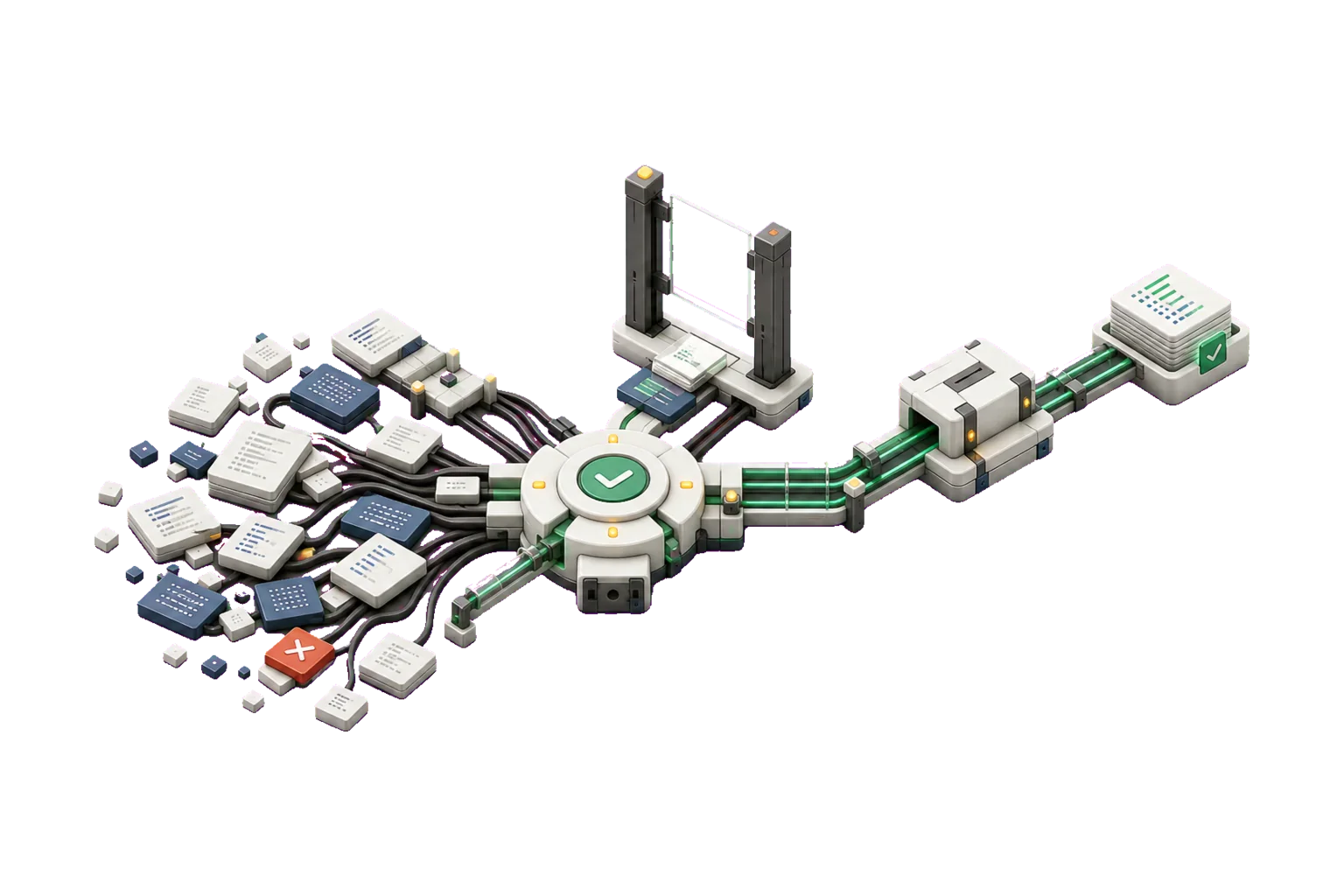
Best when the project needs control restored before another agent starts editing.
The generated files explain ownership, checks, handoff shape, review status, and stop/resume behavior. They are readable in the repo and useful even outside the Codex app.
Shared rules for every agent that enters the project.
# Project Agent Rules

- Preserve user changes. Never revert unknown work.
- Keep one active writer in the main worktree by default.
- Treat external effects as explicit operator actions.
- Record proof commands and residual risk before declaring done.
- Use the factory docs as the routing source of truth.Mode, review posture, permissions, stop rules, and verification cadence.
work_mode: balanced
user_involvement: principal_partner
concurrency_policy: single_writer
verification_level: focused_plus_build
reviewer_policy: risk_triggered
default_stop_mode: drain_to_checkpoint
external_effect_policy: explicit_operatorWhat changed, what passed, who owns the next step, and what remains risky.
## Current State

status: running
active_owner: builder-thread
current_slice: install flow and landing shell
accepted_evidence:
- npm run typecheck
- npm run build
- browser smoke on desktop and mobile
next_action: review generated asset integrationA scoped work package with enough evidence for review or resume.
## Handoff Bundle

objective:
write_scope:
non_goals:
files_changed:
proof_commands:
known_risks:
recommended_next_action:
stop_or_resume_notes:A small index of what was reviewed, accepted, deferred, or blocked.
## Review Index

| Slice | Reviewer | Result | Evidence |
| --- | --- | --- | --- |
| landing shell | reviewer-thread | accepted | build, browser smoke |
| install copy | reviewer-thread | accepted | source readback |
| mode graphics | pending | needs visual QA | desktop/mobile screenshots |Use Software Factory when you want a lightweight protocol that lives with the codebase. Use Agentic Factory when you want SQLite-backed state, CLI controls, durable event history, verification records, and a larger control plane.
Portable skill, seeded docs, mode presets, handoff templates.
DB-backed plugin, CLI control plane, event and review records.
Add the skill, restart Codex, then invoke it directly from your project thread.
npx skills add jddelia/software-factory \
  --agent codex \
  --global \
--yesnpx skills add jddelia/software-factory \
--listDISABLE_TELEMETRY=1 npx skills add jddelia/software-factory \
--agent codex \
--global \
--yesmkdir -p "${CODEX_HOME:-$HOME/.codex}/skills"
git clone https://github.com/jddelia/software-factory.git \
"${CODEX_HOME:-$HOME/.codex}/skills/software-factory"